In-app kernels as server kernels
A design note for #266: registering the kernel the Apple apps run in-app with the server embedded in the same app, so it becomes a kernel like any other.
The apps' part shipped in ganymede-ui 0.7.0 (ganymede-ui#470). The next section describes the apps before it.
The problem
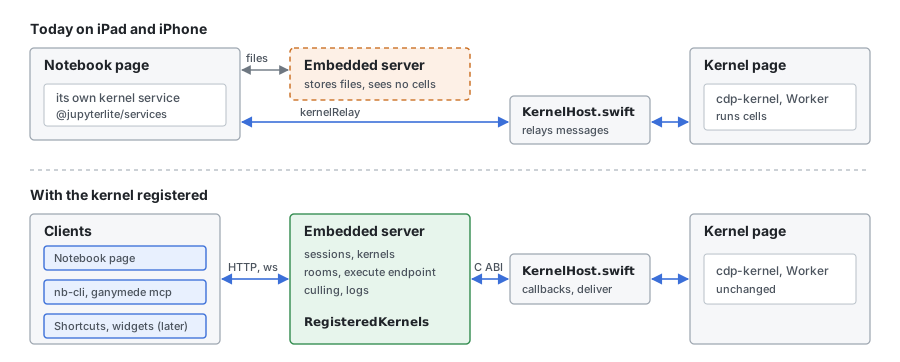
On the iPad and iPhone, a cell never reaches Ganymede. The notebook page runs its own kernel service (@jupyterlite/services, the kernels: 'page' backend), KernelHost.swift relays Jupyter messages to a hidden second web view (kernel.html), and cdp-kernel's browser kernel runs the cell in a Worker there. The server inside the app only stores files. The Mac app runs the same page kernel beside its subprocess kernels (kernels: 'both'), with the same gap.
So nothing the server adds reaches a notebook running on the in-app kernel:
- The execute endpoint, which writes outputs into a document room, and the agent tools built on it.
- Kernel lifetime: a kernel ends with the page that started it, and each window has its own.
- The kernel list, idle culling, kernel logs, and later the run contract (named parameters and results) and the run ledger.
The proposal
The app registers its kernel with the embedded server through the C ABI. The server lists it as a kernelspec, starts and stops it through the app's callbacks, and exchanges Jupyter messages with it per channel. To the rest of the server it is a kernel with no process and no ZeroMQ, which the Provisioner and TransportFactory seams already accept (Embedding).
The first step keeps today's kernel. The kernel page, the Worker and cdp-kernel's browser build stay as they are. What changes is what they talk to: Swift connects the kernel page to the Rust server instead of to the notebook page, and the notebook page uses the ordinary HTTP and websocket API, as it does against ganymede serve. The engine (a native V8 or QuickJS kernel) is a later, separate decision that this registration does not depend on.
The C ABI
Three functions and one callback table join include/ganymede.h:
typedef struct GanymedeKernelCallbacks {
    void *ctx;
    /* Start kernel `kernel_id`. launch_json: {"kernelspec", "cwd", "env"}.
     * Return 0, or nonzero to fail the start. */
    int (*start)(void *ctx, const char *kernel_id, const char *launch_json);
    /* A Jupyter message for the kernel, as JSON, on "shell", "control" or
     * "stdin". */
    void (*send)(void *ctx, const char *kernel_id, const char *channel,
                 const char *msg_json);
    /* End the kernel now. The server has already sent shutdown_request
     * and waited, as for any kernel. */
    void (*stop)(void *ctx, const char *kernel_id);
    /* No callback follows this one: ctx may be freed. */
    void (*release)(void *ctx);
} GanymedeKernelCallbacks;

/* Lists spec_json (kernel.json's keys, plus "name") as a kernelspec whose
 * kernels these callbacks run. 0 on success. */
int ganymede_kernel_register(GanymedeServer *server, const char *spec_json,
                             const GanymedeKernelCallbacks *callbacks,
                             char **error_out);

/* A message from the kernel, on "shell", "control", "stdin" or "iopub". */
int ganymede_kernel_deliver(GanymedeServer *server, const char *kernel_id,
                            const char *channel, const char *msg_json);

/* The kernel ended without being asked to. reason: "exited" or "lost". */
void ganymede_kernel_ended(GanymedeServer *server, const char *kernel_id,
                           const char *reason);
The contract:
- Messages are Jupyter JSON per channel. The shape is the websocket's JSON protocol (
header,parent_header,metadata,content), with binary buffers as base64 strings inbuffers, as today's relay carries them. cdp-kernel's browser build already speaks this throughPageChannels(deliver(channel, msg)andonMessage), so the kernel needs no change. Nothing is signed: both ends are one process. - Threads. Callbacks run on a server thread, never the app's main thread, and must not block. Swift hops to the main actor to reach the web view.
ganymede_kernel_deliverandganymede_kernel_endedtake any thread and don't block. Messages for one kernel keep their order in both directions. - Lifetime. Strings passed to a callback are valid during the call.
ctxstays the app's untilrelease, which the server calls when it stops. Whenganymede_kernel_registerfails, it never callsreleaseand keeps no pointer, soctxstays the app's to free. Registering a name that is already registered fails, and the first registration stays. Register afterganymede_server_startand before the web view loads the page, so the first kernel list includes the kernel. - Start.
startreturns at once. The server then waits forkernel_info_replywithin its startup timeout, as for a subprocess kernel.launch_jsoncarries the notebook's path inenv.JPY_SESSION_NAME(#627), which the app's permission ledger needs. - Interrupt and stop. The kernelspec says
"interrupt_mode": "message", so an interrupt is aninterrupt_requeston control, which cdp-kernel's browser kernel already handles. Shutdown sendsshutdown_requestfirst, then callsstopafter the grace period. - Heartbeat. A registered kernel is alive until
ganymede_kernel_endedorstop. - Names. A registered kernelspec's name follows the kernelspec rules (lowercased,
[a-z0-9._-]). It is listed after a kernel server's (gateway_url), in place of one of the same name, so the server's default kernel stays the default unless it has no kernels of its own.
On the Rust side, a RegisteredKernels type implements KernelspecSource, Provisioner and TransportFactory over the callbacks, and ganymede-ffi puts it in front of the gateway's kernels, or of none. A test drives a fake kernel through the C functions, and tests/smoke.c registers one.
What changes in each repository
- ganymede: the functions above,
RegisteredKernels, the header, and Embedding. This closes #266. - ganymede-ui, Swift:
KernelHostregisters the TypeScript kernel at server start and maps the callbacks onto the kernel page's existingstart,send,messageandclosedoperations. The kernel page belongs to the app rather than to a window, since kernels now outlive windows and reloads. The ledger takes a kernel's notebook fromlaunch_json;movedanddeclaredstay as they are. - ganymede-ui, web: in the apps, the notebook page connects with the
ganymedebackend and lists the server's kernels, the in-app one among them.kernel-relay.tsloses its notebook-page half. In a browser with no server, page kernels work as today. - cdp-kernel: none expected.
When the kernel is lost
iOS ends a suspended app's kernel after about 30 seconds, and ends the kernel page's process under memory pressure. Today the notebook page shows the kernel as dead with Restart, and state and unsaved outputs are gone.
With registration, Swift calls ganymede_kernel_ended(server, id, "lost") for each kernel the page held. The server treats it as a crash with two differences:
- It restarts the kernel, unless restarts are off (
restart_limit0), without counting towardrestart_limit, since the platform ended it, not a fault in the kernel. With no count, a kernel the platform keeps ending restarts each time; see Restart after a loss below. A loss before the kernel's firstkernel_info_replyis a failed start: the server launches it up to three times in all, as for any kernel. - The
status: restartingmessage on iopub carries"reason": "lost"in its content. Clients that don't know the key ignore it, as Jupyter clients ignore unknown content keys.
The app can then show "iOS stopped the kernel while the app was in the background" with a Restore action. Restore re-runs, on the new kernel, the cells that had run, in the order of their execution counts, and stops at the first error. It runs each cell's current source, so a cell edited after it ran runs as edited; the action lists the cells before it runs them. Outputs survive the loss because they live in the notebook (and, since ganymede-ui opens notebooks through rooms, in the server's document), not in the kernel.
The first version of Restore is a ganymede-ui action over the ordinary kernel client, or over the execute endpoint now that the app uses rooms. When the run contract lands, it becomes "run this notebook's executed cells", a server operation any client can call.
"exited" is a kernel that ended for its own reasons, such as a Worker that failed to load. It follows the ordinary crash path and counts toward the limit.
Capabilities
Kernels differ in what cells can use: real files, node: modules, the device API, the debugger. The in-app kernel lacks most of what a Mac subprocess kernel has, so the picker and errors should say so.
- Before a kernel starts, the kernelspec says what it offers, in
metadata.capabilities, an object keyed by name (fs,node,device,debugger,stdin), the same shape askernel_info_reply.capabilitiesbelow, so a client reads both one way. A value istrue, or something more specific, such as the methods of a namespace. The host passes kernelspec metadata through untouched, so this needs no server change. The kernel picker shows them as badges, and lists in-app and remote kernels together. - Once it runs,
kernel_info_reply.capabilitiessays what it got. cdp-kernel already setscapabilities: { device: true }there when the app gives the kernel page adevicebridge. - Later, a cell error caused by a missing capability names it, so the page can offer to run the cell on a kernel that has it. That needs an error convention in cdp-kernel and is not part of the first step.
Where the kernel core runs with a native engine
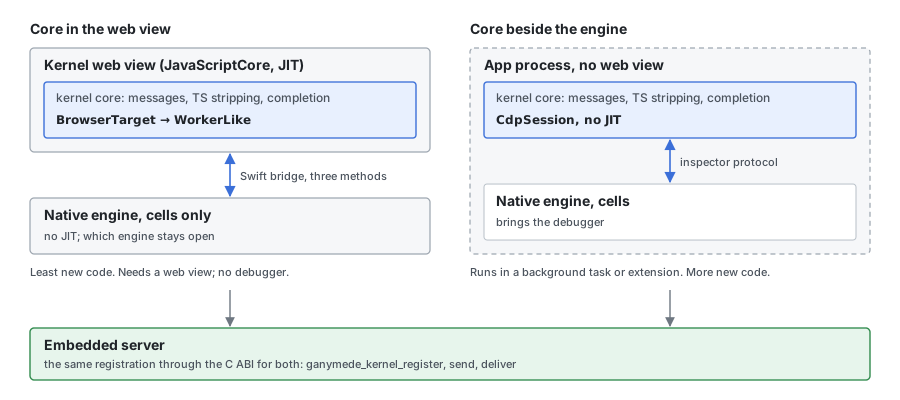
The first step keeps the Worker. When a native engine replaces it, the kernel's own code (message handling, TypeScript stripping, completion, later a bundler) can run in one of two places. Both use the same registration, so this choice doesn't change the C ABI.
- In the web view, behind
WorkerLike.BrowserTargetreaches its Worker through three methods (postMessage,addEventListener,terminate). A Swift object with those methods can stand in front of the native engine, and the kernel core stays in the web view, where JavaScriptCore has its JIT. This is the least new code. It needs a web view, and it has no debugger, sinceBrowserTargetdrives cells with its own messages rather than the inspector. - Beside the engine, over the inspector. The kernel core runs in the app's process with the engine and drives cells through the inspector protocol, as cdp-kernel's CDP targets do. The debugger comes with it, and it runs where no web view can: a background task, an extension. It costs more new code, and the core runs without a JIT.
I would start in the web view and move the core beside the engine when the debugger or runs without a web view are wanted. Either way, a run with no web view needs scripts stripped and bundled when they are saved. Which engine (rusty_v8 without JIT, or QuickJS) stays open, to be decided by measuring a build.
Why the C ABI
The C ABI grows by three functions, a callback table, and their unsafe glue, in the patterns ganymede-ffi already uses. Nothing existing changes. It adds no network surface and no dependency.
The alternative was a websocket endpoint where the kernel page dials into the server as a kernel. It needs no C change and would also work in a browser tab. It was set aside because:
- It opens a new network endpoint that receives every cell sent to a kernel, to be protected beyond the token.
- The server still can't start the kernel page, so
startandstopwould need the C ABI anyway, and the kernel would be split across two channels. - A native engine has no page to dial from. The C ABI serves today's kernel, a native one, Pyodide and a later SQL kernel alike.
The cost of going through Swift is one more hop per message, which today's relay already pays.
Open questions
- Restart after a loss. The proposal restarts at once, so the notebook has a kernel when the app comes back. The alternative leaves it dead until the person picks Restart or Restore, which starts no kernel the person didn't ask for. Losses don't count toward
restart_limit, so nothing yet caps or spaces out restarts after repeated losses, such as a page killed under memory pressure each time it starts. - Where the kernel web view lives on the Mac. WebKit suspends a web view in no window. With kernels owned by the app, the kernel web view needs a home that outlives any one window.
- Synchronous requests from page kernels. The TypeScript kernel doesn't use the service-worker relay, but JupyterLite's kernels, the planned Pyodide one among them, read files and ask for input through it, answered by the notebook page's kernel service. Once that service is gone, Pyodide would read files through the server's contents API and ask for input over the stdin channel. This matters when Pyodide registers, not for the first step.
What this leaves out
The engine choice, Pyodide's order, Shortcuts and widgets on the kernel, pairing with a Mac, and the kernel picker's design. Each can build on the registration once it exists.