A host API for kernels
A design note for #647: a way for cell code to ask the Ganymede server for things, such as reading, searching and running other notebooks, without giving the kernel a server token. The design was agreed on 2026-11-10, with the decisions at the end. The first step is built; What's built says which.
What's built
The server opens the host comm to every kernel with subshells, keeps its traffic from other clients, and answers hello, notebooks.list, notebooks.read, notebooks.search and notebooks.results, with the [host] read grant from the config file (Reference), and self.add, self.edit and self.delete, unless [host] edit_self is off, and notebooks.run under the [host] run grant (none by default). A notebook's own grant, set with ganymede grant, replaces those defaults for it, and clients set it over HTTP with /api/host/grants. cdp-kernel's client is jupyter.host(). In the apps, Kernel > Notebook Access… (the ⋯ menu on the iPad and iPhone) shows what a notebook asks for and sets its grant.
ganymede execute answers its kernels' calls as well, under [host] with --grant read=PATH or run=PATH in place of a key (Reference).
notebooks.run (and POST /api/notebooks/run) take save: "copy", which keeps the executed notebook under runs/ (Run copies).
The rest of this page is the design.
The problem
A cell can ask the app for things through the device API. It can't ask the server for anything. Since #627 a kernel learns its notebook's path from JPY_SESSION_NAME, and that is all it learns. It has no server URL and no token.
That blocks the notebooks-from-notebooks use cases: a journal index that lists every journal, "what do I already know about X" searched from a cell, a new journal that reads an older one's named results, and a notebook that re-runs another one with new parameters. On a desktop, a Node or Deno cell can read files itself, but it can't see a notebook that is ahead of its file in a room, can't run a notebook in a fresh kernel, and has no search. A kernel in the iPad and iPhone app has no file system at all.
The obvious fix, passing the server's URL and token to the kernel, gives every cell the whole API: terminals, other kernels, every file under the root. An agent's cell would get the same. This note proposes a narrower channel instead.
| What a cell needs | How it travels | Here? |
|---|---|---|
| Which notebook it is | Environment at launch (JPY_SESSION_NAME) | Already on main |
| Run parameters | Data at launch (the run contract) | No, see The run contract |
| Named results | An output with a MIME type | No, see The run contract |
| Other notebooks: list, read, search, results, run | A live call to the server | Yes |
| Secrets | A live call to the server | Later, same channel |
| Device features | A live call to the app (device) | No, built |
The first three need no new protocol: data goes in at launch and comes back in outputs. The host API is for what needs a live answer.
The proposal
The server opens a comm to each kernel it starts, and answers calls on it under a namespace, host, beside device. The app answers device; the server answers host. The kernel never holds a token, and what each kernel may ask is granted per notebook, on the server.
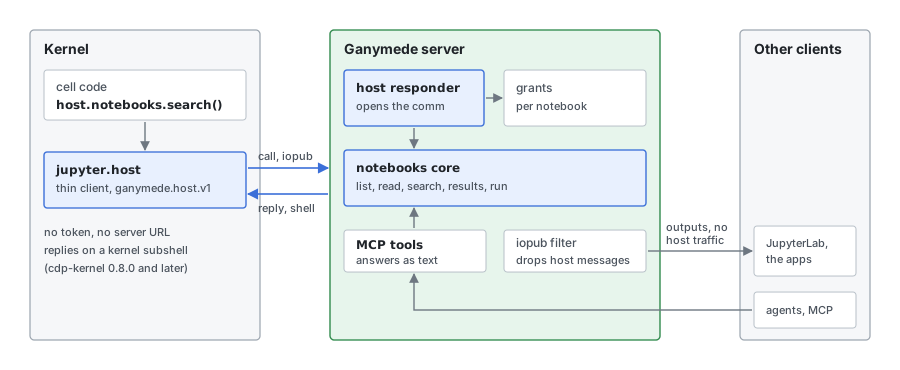
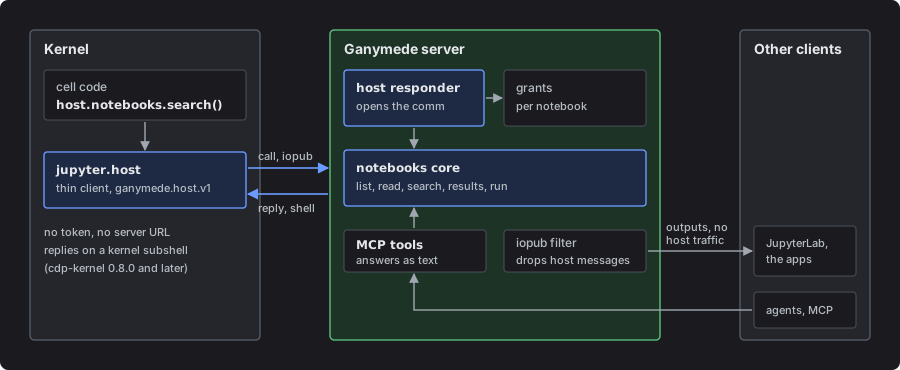
In a cell, with cdp-kernel:
const host = await jupyter.host();             // null when no server answers
host.notebook;                                 // "journal/2026-11-11-quakes.ipynb"
host.has("notebooks.run");                     // false unless granted

const journals = await host.notebooks.list({ dir: "journal" });
const hits = await host.notebooks.search({ query: "weekday drop", dir: "journal", outputs: true });
const { notebook } = await host.notebooks.read({ path: hits[0].path });  // nbformat JSON
const results = await host.notebooks.results({ path: "journal/2026-11-09-fremont-bridge.ipynb" });
results.weekday_drop;                          // -0.19

const run = await host.notebooks.run(
  { path: "journal/2026-11-09-fremont-bridge.ipynb", params: { counter: "2nd Ave" } },
  { signal: jupyter.signal },                  // an interrupt stops the run
);
run.status; run.results;
A read-and-query package for notebooks (the notebooks-from-notebooks research's level 1) sits on top of these calls: journal views, findings, named results. Where that package lives is still open; it isn't part of this note.
Transport: a comm the server opens
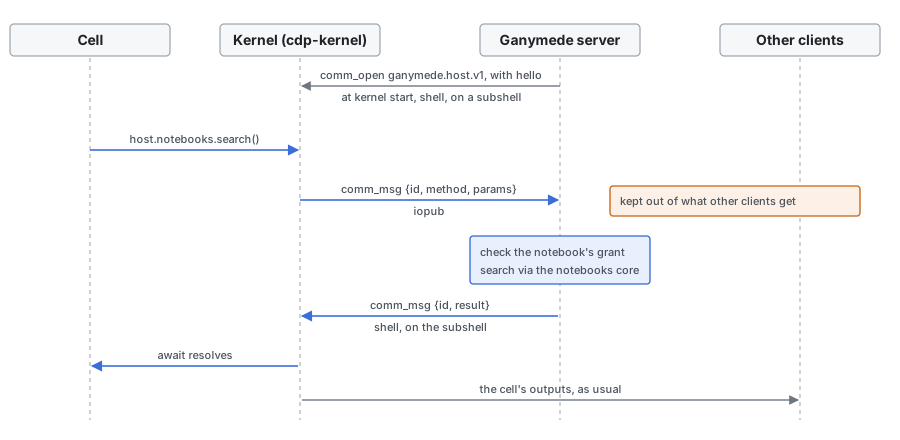
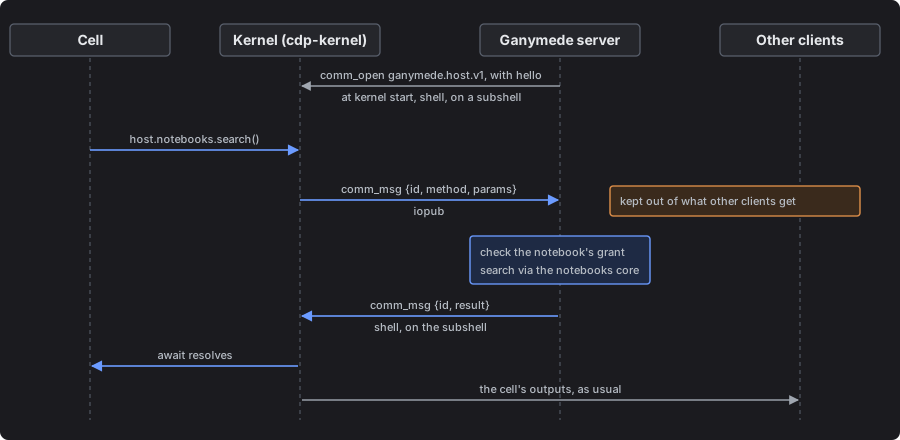
When a kernel's first kernel_info_reply arrives, the server sends a comm_open on shell to target ganymede.host.v1, with its hello reply as the open's data. After a restart it opens a new one.
- A kernel without the client loses nothing. A kernel with no
ganymede.host.v1target answers the open withcomm_close, as cdp-kernel and ipykernel both do, and the server stops there. Cells that never callhostsee no difference. - Calls go from the kernel to the server as
comm_msgon iopub:{ id, method, params }, and{ id, cancel: true }when the cell aborts. This is thedevicecomm's message format, so the client code is shared. - Replies go from the server to the kernel as
comm_msgon shell:{ id, result }or{ id, error: { code, message } }, with thedeviceerror codes (unavailable,denied,cancelled,timeout,failed,disconnected). Shell isn't broadcast, so no other client sees a reply. - Subshells. A cell that awaits a call is still running, so a reply on the main shell would wait behind it forever. The server asks for a kernel subshell (
create_subshell_requeston control) before opening the comm, and sends the open and every reply on it. cdp-kernel has subshells since 0.8.0. A kernel that lists nokernel subshellsinsupported_featuresgets no host comm, since every awaited call on it would hang. - Kept from other clients. The server forwards a kernel's iopub to every connected client. It drops from that stream the host comm's
comm_msgandcomm_close, and thestatusmessages whose parent is one of its own host messages. JupyterLab and the apps never see the comm, so thedeviceproblem (a client closing a comm whose target it doesn't know) can't arise, and a call's parameters stay between the kernel and the server. A process that reads the kernel's ZeroMQ iopub socket directly, with the connection file, still sees calls, as it sees every output. - No pings. The
devicecomm pings because a frontend can vanish without closing. The server is the kernel's host and learns of a kernel's death directly, so a dead kernel's calls end with it.
A client that loads late
cdp-kernel registers ganymede.host.v1 when it starts, so it is ready for the open. A client that loads later, such as a Python package a cell imports, has missed it. Such a client opens the comm itself, to the same target, with no data. The server takes a kernel-opened comm to ganymede.host.v1, keeps it from other clients like any host message, answers with hello over it, and then treats it as the host comm. One kernel has one host comm: a second open is closed with { error: "taken" }.
Which server answers
The server that launched the kernel answers. In the apps that is the embedded server, and a kernel registered through the C ABI (In-app kernels as server kernels) gets the comm the same way, so the in-app kernel needs no transport of its own. A kernel behind a kernel server (gateway_url) is launched by the remote server, so the local one opens no host comm for it. If the remote is Ganymede, it answers with its own grants.
The calls
Every call takes a JSON object and resolves with JSON. Paths are API paths, relative to the server's root, as in the contents API. The first version has these:
| Method | Params | Result | Granted by default |
|---|---|---|---|
hello | {} | { protocol: 1, server, notebook, methods }: the server's version, this kernel's notebook path (or null) and the methods it may call | Always |
notebooks.list | { dir? } | [{ path, title, kernel, modified }] for notebooks and directories in dir | Yes, under read |
notebooks.read | { path } | { notebook, hashes }: the notebook as nbformat 4 JSON, from its room when one is open, so it includes what isn't saved yet, and each cell's source hash by cell id | Yes, under read |
notebooks.search | { query, dir?, outputs?, cell_type?, limit? } | { hits: [{ path, title, index, id, cell_type, in, excerpt }], total, truncated }, the notebooks_search tool's matches as data | Yes, under read |
notebooks.results | { path } | { name: value }: the notebook's named results, from its outputs, read from its room when one is open, like notebooks.read | Yes, under read |
notebooks.run | { path, params?, save?, timeout? } | { status, results, error?, path?, copy? } | No |
self.add | { cell_type, source, after? } | { id } of the new cell in the calling notebook | Yes |
self.edit | { id, source, source_hash } | {}, or failed with source_mismatch when the cell changed since it was read | Yes |
self.delete | { id, source_hash } | {}, with the same check | Yes |
has(method) is answered in the kernel from hello's methods, so a cell can check before it calls.
The self.* calls edit only the notebook the kernel was started for, through its room, so every client sees the change live. They use the MCP cell tools' code and the execute endpoint's source hash (MurmurHash2, seed 0), so a cell can't overwrite an edit it hasn't seen. The hash comes from notebooks.read, which returns each cell's beside the notebook, so a client needn't compute it. A notebook may always read itself, whatever its read grant, so a narrowed grant can't leave self.* without hashes. They cover the most common edit a notebook makes, regenerating a table or summary in one of its own cells, such as a journal index. A kernel with no notebook has no self.* calls.
Cells the self.* calls write carry provenance with by set to kernel: a cell self.add makes gets metadata.ganymede.agent = {"by": "kernel", "mode": "note", "at": "<time>"}, and self.edit keeps the source it replaced in the cell's history, as cell_edit does. Once a kernel uses self.*, the server keeps its notebook's room open until the kernel ends, as it does for an MCP connection, so the ids self.add returns stay valid in a notebook saved without cell ids (nbformat 4.4 and older) even when no client has it open.
Later, on the same channel and the same grants:
notebooks.edit: theself.*calls for other notebooks, behind a grant. Not needed by the notebooks-from-notebooks use cases yet.secrets.get: a named secret the notebook is granted, from a store the server keeps. Its reply is the reason replies stay on shell.runs.list: the run ledger, once it exists.
notebooks.run
Runs another notebook in a fresh kernel, with parameters, and returns its status and named results. It is one front door to the run contract, beside ganymede execute -p and an HTTP endpoint, so it waits on that contract's first step.
- The notebook's own kernelspec runs it. A TypeScript notebook can run a Python one if the server has a Python kernel.
saveisfalseby default: the run's outputs go nowhere but the result."copy"writes the executed notebook underruns/and returns its path ascopy(Run copies), only when the calling notebook may read the notebook it runs as well as run it. Writing back into the notebook itself is not offered from a cell.- An abort (
{ signal: jupyter.signal }, which an interrupt aborts) sendscancel, and the server shuts the run's kernel down. - A run never widens its caller's grant. The run's kernel gets the intersection of the called notebook's grant and the caller's, so a notebook can't reach more by running another one. A path must pass each grant up the chain with symlinks resolved, so a grant that names a symlink reaches nothing its caller can't.
- Depth and width. A run started from a run counts one deeper, and the server refuses past depth 3 (
denied). Each kernel has at most two runs of its own in flight; more wait their turn. The limit counts per calling kernel, not per notebook, so a notebook that runs itself can't wait on a slot its own caller holds: every run in a chain has its own kernel and its own two slots.
Errors and trust
- A call that isn't granted fails
deniedand names the grant it needs, so a cell can say what to ask for. A method the server doesn't have failsunavailable. - What comes back from another notebook is data written by whoever ran that notebook, possibly an agent reading a web page. A cell, or an agent reading its output, should treat it as untrusted input. The host API doesn't mark it trusted, and named results are JSON, never HTML.
Grants
A grant says what a notebook's kernel may ask the server for. The server keeps grants; a notebook can't grant itself.
# ganymede.toml: defaults for every notebook
[host]
read = [""]          # API paths the notebooks.* reads may reach; "" is the root
run = []             # notebooks this notebook may run; [] is none, [""] is all
edit_self = true # the self.* calls; false turns them off- Defaults come from
[host]in the config file. Out of the box a notebook may list, read, search and read results of notebooks under the root, may edit its own cells (self.*), and may run none. A Node or Deno kernel can read those files already, and an in-app kernel needs reads to do anything. - Which notebook. A kernel gets the grant of the notebook whose session the server started it for: that session's API path, mapped to its file id, which
helloreports asnotebook. It is the notebook whose OS path goes intoJPY_SESSION_NAME, but the server reads its own session record, the first it sees for the kernel, not the variable. Another session that joins the same kernel (a console attached to it) adds nothing. A kernel started byPOST /api/notebooks/run(links with parameters, the apps' Run Notebook, HTTP clients) has no session: it gets the grant of the notebook it runs, which the server names in its launch variables, with noself.*calls, since a run writes at most a copy. It follows the notebook by file id, so a rename through the contents API during the run keeps its grant; a rename outside the server (Finder,git mv) isn't seen. If the notebook is deleted during the run, the run has no grant at all, not the defaults, andnotebookisnull. A kernel started with no notebook gets the defaults, andnotebookisnull. - Paths in calls and grants are normalized as the contents API normalizes them: relative to the root, with no
..and no way out of the root through a symlink. A grant's path matches whole segments, sojournalcoversjournal/x.ipynbbut notjournal-private/, and is matched against where a path leads once symlinks are resolved, so a symlink in a granted folder doesn't reach another. - Per notebook grants add to or narrow the defaults, keyed by the notebook's file id, so they follow a rename or move. They live beside the file id database, not in the notebook.
- Asking. A notebook may list what it wants in
metadata.ganymede.host.wants, for example["notebooks.run"]. That grants nothing. A client shows it and lets the person grant it, the way Trust Notebook works for outputs. A downloaded notebook that asks for everything gets nothing until someone says yes. - Granting is
ganymede grant <notebook> run=<path>on the command line first, with--listto show a notebook's grants (or every notebook's) and--revoketo remove one, then a sheet in the apps. A notebook with no file (an untitled console) gets the defaults. ganymede executeuses[host]from the config with--grant read=<path>or--grant run=<path>in place of a key as the defaults, and a notebook's own grant over them, as a server does. It gives its kernels noself.*calls, since it writes the notebook itself when the run ends.
This is the server's half of "scoped kernels" from the direction review: it limits what a kernel can ask the server for. It doesn't limit what a kernel's own code can do on the machine. That is the OS sandbox around the kernel process, a separate step that can read the same grants.
One implementation, two doors
The MCP tools already read, search and run notebooks, but their answers are text for a model, in nb-cli's @@cell format. The host API needs the same operations returning data. So the work splits the tools in two:
- A notebooks core that returns data: list, read (room or file), search, results, and later run and edit.
mcp/search.rsalready works this way, returning hits as structs. - The MCP tools render the core's answers as text, as today.
- The host responder checks the grant and returns the core's answers as JSON.
The comm driver (open on start, the subshell, routing replies, the client fan-out filter) and the file-based core go in a new crate, ganymede-host, with two users. ganymede-api's kernel manager opens the comm for the server's kernels and filters host traffic in its iopub fan-out (Clients::dispatch in bridge.rs). ganymede execute answers with the server's own responder and no listener (serve::LocalHost), so the grant checks and the runs are the same code. ganymede-server adds what needs a server: reads from open rooms, and the per-notebook grants. The crates under it stay language-free: the server sees method names and JSON.
The run contract
Theme A of the direction review gives a run three parts: parameters passed as data at launch, named results published as outputs, and one way to run a notebook. notebooks.run and notebooks.results depend on the last two.
The run contract's first step (#650) passes parameters as a JSON object in GANYMEDE_PARAMS, which cdp-kernel exposes as jupyter.params. Named results are display_data outputs with the MIME type application/vnd.ganymede.result+json, holding { "name": "weekday_drop", "value": -0.19 }, which cdp-kernel's jupyter.result() writes. Scrapbook's outputs (application/scrapbook.scrap.json+json and application/scrapbook.scrap.text+json) are read too, so Python notebooks written with scrapbook's glue work as they are, and when a name appears more than once the last output wins. A language-free reader in ganymede-nbformat collects them, and notebooks.results and notebooks.run use it, so the host API adds no channel of its own for parameters or results.
What changes in each repository
- ganymede:
ganymede-host(comm driver, file-based notebooks core,hello, thenotebooks.*methods), the iopub filter in the kernel manager, the MCP tools moved onto the core, grants in the server and the config file,ganymede grant, and a page in the docs. The protocol page records theganymede.host.v1target and its messages. - cdp-kernel:
jupyter.host(), a client that registersganymede.host.v1at start, waits for the open, and calls with{ signal }. It shares the call and error code withganymede-device's comm transport. - ganymede-ui: nothing for the first step. Later, the sheet that shows a notebook's
wantsand grants them, andhas()badges. - ganymede-device (now ganymede-ui's
packages/device): none.devicekeeps its transports, since the app answers it, not the server.
The order: the comm and the read methods in Ganymede, then jupyter.host() in cdp-kernel, which is enough for "what do I already know". The self.* calls come next, which complete the journal index. notebooks.run follows the run contract's first step. Granting in the apps comes last.
Why a comm and not a token
The alternative was to pass GANYMEDE_SERVER_URL and a token scoped to notebook calls in the kernel's environment, with the calls as HTTP endpoints.
- A token in the environment leaks into child processes, logs and outputs (
console.log(process.env)), and a cell can send it anywhere. The comm gives cell code nothing to copy: only calls on a channel the server checks. - A scoped token is a second authorization system beside the server's one token. Grants checked by the responder are one place.
- The in-app kernel and a kernel on WASI have no network route to the server. A comm travels on the kernel's own channels wherever it runs, including through the C ABI.
- It adds no network surface: no new endpoint, and no listener the kernel dials.
What it costs: it needs subshells to answer a waiting cell, so kernels without them get no host API, and each language needs a small client. That client is a comm target and a request map, about the size of ganymede-device's comm transport.
Decisions
Thomas settled the four open questions on 2026-11-10:
- Default reads cover the whole root. A desktop kernel can read those files already, so a narrower default would add a grant without protection. Limiting what an agent's code can do on the machine is the OS sandbox's job. On the iPad and iPhone the root is the app's own notebook folder. The Mac app's root is
/, so it narrows the default to the folders under Settings › General › Spotlight (ganymede-ui#585); with none, a notebook reads only itself. That limits what the host API hands a notebook, not what its code can read from disk: the Mac app isn't sandboxed, and its kernels are ordinary processes. - Grants are kept by file id, so they follow a notebook that moves.
ganymede grant --listand--revokeshow and remove them, in place of editing a file by hand. - Kernels without subshells get no host API. cdp-kernel and ipykernel 7 have subshells. A second, callback-style way to call waits until a kernel that needs it comes up.
- A notebook may edit itself through the
self.*calls, granted by default, as the step after the read calls. Editing other notebooks stays for later.
What this leaves out
Secrets and their store, the OS sandbox, the run ledger, edits to other notebooks, and where the notebooks read-and-query package lives. Each builds on this channel and these grants.