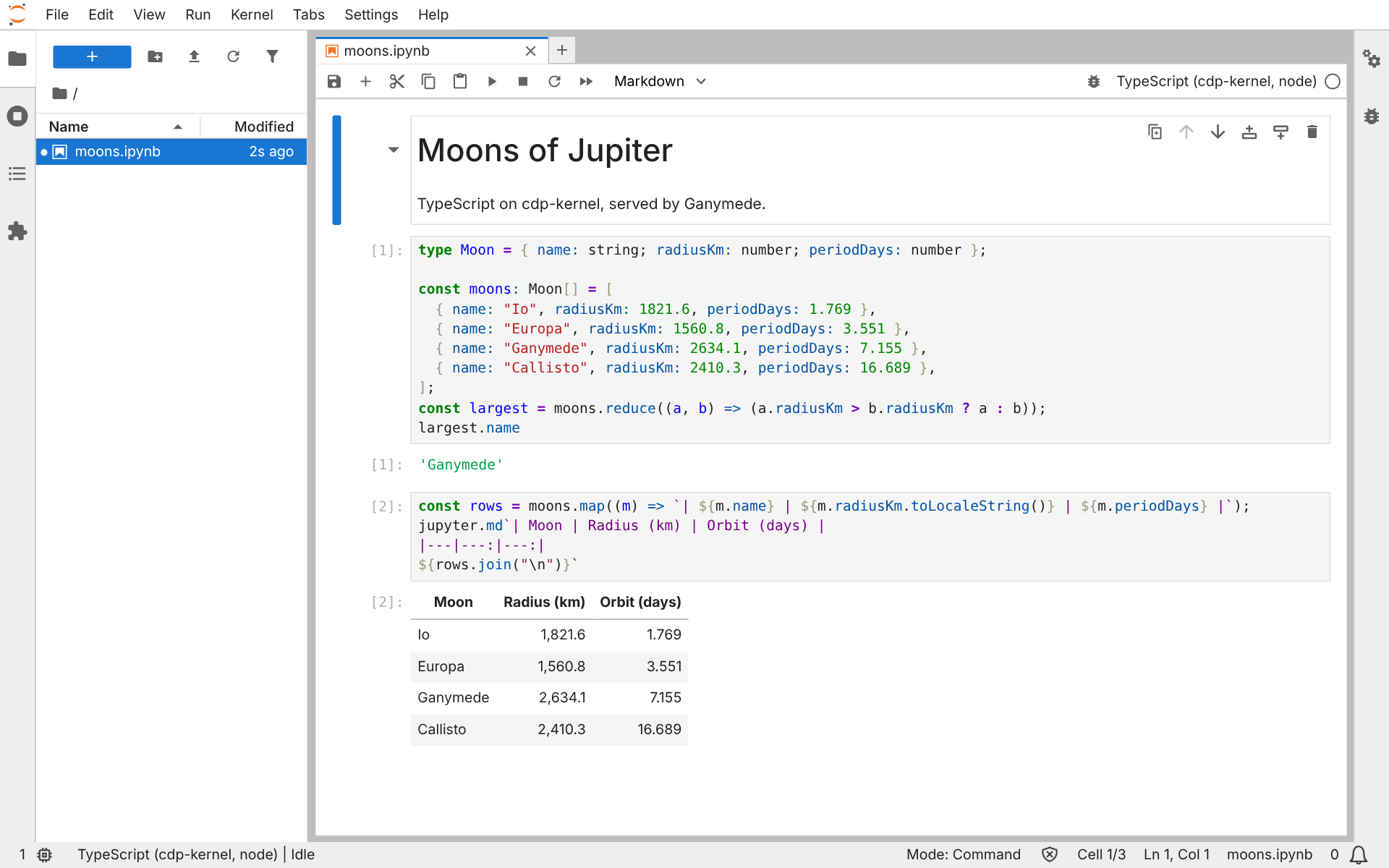
Ganymede runs your kernels and serves the same API as
jupyter_server, so JupyterLab and VS Code connect to it unchanged. It is
one Rust binary, or a library to embed, and it needs no Python environment to run a
TypeScript notebook, or any other.
For people who want Jupyter where a Python environment is a burden or
impossible: TypeScript notebooks on cdp-kernel,
CI jobs that run notebooks, and apps that embed a notebook server.
# Linux, macOS: latest release, plus cdp-kernel if Node 24+ is installed
curl -fsSL https://ganymede-server.com/install.sh | sh
ganymede kernelspec list
JupyterLab from ganymede lab, running a TypeScript notebook on
cdp-kernel.
Serve, then connect
ganymede serve prints a URL with its token. Paste it into VS Code's
Existing Jupyter Server, or open JupyterLab's own bundle from it, and pick any
kernel you have installed: cdp-node for TypeScript, python3
if ipykernel is there.
No server at all for scripts and CI: ganymede run sends code to a
kernel and prints the output, and ganymede execute writes the same
notebook jupyter execute would.
sh
$ ganymede serve --root-dir ~/notebooks
http://127.0.0.1:8888/?token=4f9c…$ ganymede run -k cdp-node 'const x = 2; x * 21'
42
$ ganymede execute report.ipynb --inplace
One binary covers jupyter server, jupyter execute,
jupyter kernel, and jupyter kernelspec.
Where to start
The docs are grouped by how much you already know.
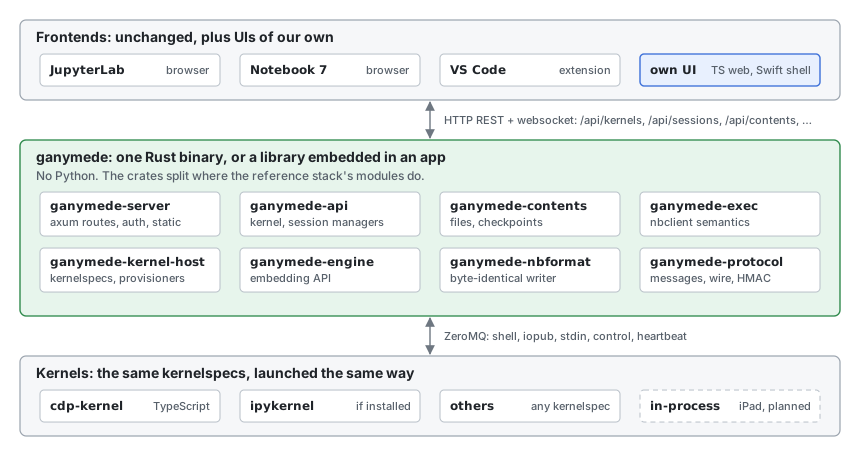
The server, kernel host, notebook format, and executor are Rust, with no Python
dependency. Python appears only as a kernel someone installed, as the reference
CI compares against, and as the format the notebook writer matches.
ganymede lab install unpacks JupyterLab's JavaScript from its PyPI
wheel without running Python. Details
Any kernel
Kernels come from the standard kernelspecs in the Jupyter data directories. The
host knows no language; the same tests run on cdp-kernel and ipykernel.
Existing frontends
The jupyter_server REST and websocket API, both websocket framings,
and JupyterLab's /lab/api/* endpoints.
Parity with jupyter execute
Notebooks come out as nbclient writes them, and saves are byte-identical to
Python's nbformat, so git sees no churn.
Embeddable
ganymede-engine is a library: start kernels, execute with streaming
output, run notebooks. It builds for iOS, Android, and wasm.
Files as the source of truth
Atomic writes, modification-time conflict checks, and checkpoints outside the
notebook folder, so synced folders such as iCloud Drive stay intact.
Where it fits
Ganymede takes jupyter_server's place and keeps both of its
interfaces: the API above it and the kernels below.
Client
How it connects
Status
VS Code
The Jupyter extension's Existing Jupyter Server, with the URL and token.
Nothing in the Jupyter protocols requires Python, but the server does: running a
TypeScript notebook means installing a Python environment first. That rules out
places Python can't easily go, such as an iPad app. Ganymede keeps the protocols and
the ecosystem and drops the dependency.
Early software. An end-to-end suite compares it against jupyter execute
and jupyter server on cdp-kernel and ipykernel, on Linux and macOS.
Windows builds but is not tested end to end. Known gaps